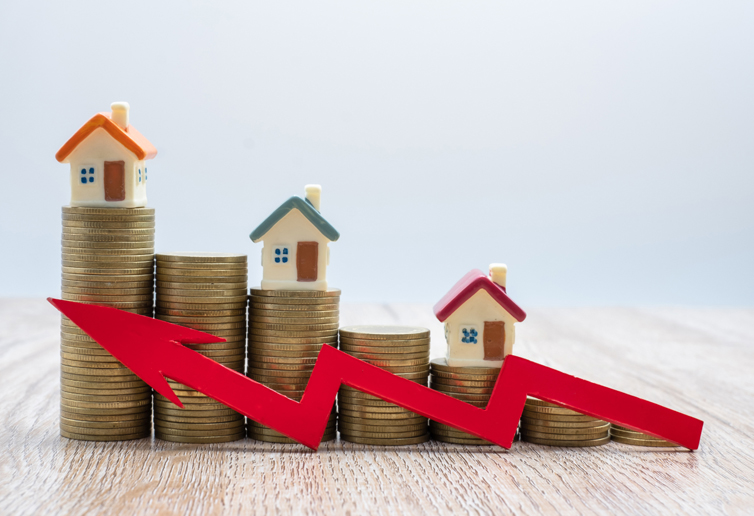
Doomsayers have been predicting it for years: House prices will collapse. After all, there has never been a boom in history that hasn’t eventually been followed by a bust.
And the bigger and longer the boom, then obviously, the bigger the inevitable bust.
Are we now seeing the start of the great bust? Or is this another blip in the market – and prices will soon boom again?
Many home sellers are hoping for the latter. In doing so, of course, they could find themselves stuck on a downward slope wishing they had sold now rather than waiting for another boom.
As of mid-2026, there are almost 250,000 properties listed for sale (248,249 according to SQM Research). That’s 14,000 more than at the same time last year.
Many of these sellers are holding out for boomtime prices. Most are likely to be bitterly disappointed.
Like the owners of a lovely home in Atheldene Drive in Glen Waverley. Last year they were offered $1.88 million. They refused. They wanted at least $2 million.
The agent warned them – the economic climate is getting worse.
But these sellers – like most sellers – blamed their agent. If he couldn’t get their minimum price of $2 million, they’d get another agent. Which is exactly what they did.
This lovely home – for which the owners were offered $1.88 million in April last year – went to auction in June this year. It sold for $1.68 million.
That’s a two-hundred-thousand-dollar cost of being stubborn. Of waiting and hoping instead of asking the most important question all sellers should ask: Does the price we can get today enable us to move on with our life? If the answer is yes, then stop fretting that you didn’t sell yesterday. Yesterday’s price has gone. If you want to sell today, you must accept today’s price.
TOMORROW’S PRICE.
What about waiting?
Some sellers are saying, “I will wait for my price”. And if agents try and warn sellers that prices may go lower, the sellers accuse them of “conditioning us”.
Sometimes that’s true. The main goal of most agents is to make a sale – at any price.
But in the current climate, it’s more likely to be true that if you reject an offer today, you may regret it in a few months from now.
After all, the current negative predictions are as bad as they’ve ever been.
All the major banks are forecasting that house prices will fall. The chief economist for HSBC, Paul Bloxham, is saying that the current downturn is “just the beginning”.
Morgan Stanley is just as bearish.
But the most frightening prediction comes from leading economist Christopher Joyce who says we’ll soon witness “the mother of all price corrections”.
And, depending on whom they are speaking to, agents and their spokespeople will say whatever suits their agenda. If they want sellers to sell, they will cite doom and gloom predictions.
If they want buyers to buy, they will talk the market up.
For instance, last weekend seven out of ten homes offered for auction failed to sell. Hundreds of home sellers across the country unwittingly turned their homes into lemons. There are no properties more shunned – and likely to attract lower offers – than those that fail at auction.
But, of course, one of the nation’s property spivs was saying that last week’s auction clearance rates were “a positive sign”. He was quoting from the industry figures which are pumped up by almost twice the truth. Fake auction figures are more common than fake reviews these days.
So, will tomorrow’s insanely high property prices come back?
Or are we in for “the mother of all property crashes”?
The most truthful answer is three words: No one knows.
POINTS TO REMEMBER.
When Covid began, almost every economist said prices would crash. Most agents agreed.
The opposite happened.
So, the first point to remember is that most experts have no better idea than the average person in the street.
The second point to remember is that falling prices can benefit more people than they harm.
The people who get hurt most in a property crash are those who bought at the peak of a boom. But real pain only comes if they sell. Most people buy homes for the long term. If they can hang on – as most do – their boom time purchase price will one day seem cheap – even if that day is years away.
Also, many people who are selling a home plan to buy a better home. So, if prices fall 10 per cent and million-dollar homes fall by $100,000, then two-million-dollar homes will fall by $200,000.
Therefore, those who are selling for one million and buying for two million will be $100,000 better off if prices fall by ten per cent.
The third – and most important point – is this question: What’s more important in your life, your money or your happiness?
So often, sellers hold out for a price that’s never coming (or a long time coming) only to see their dreams crushed by obstinacy.
An elderly Sydney couple who wanted to sell their home so they could be closer to their grandchildren are one of thousands of examples. They hung on for so long waiting for a price that never came. They both passed away without ever feeling the joy of living near their grandchildren.
THE BEST PRICE.
The best price in today’s market is likely lower than the best price in yesterday’s market.
But you can’t get yesterday’s price today.
You can only get today’s price today. And, if you refuse to accept today’s price, then, like the sellers in Glen Waverley, you may find that tomorrow’s price is lower than today’s price. Don’t let stubbornness cost you $200,000.
Some sellers – especially those who read our articles – say, “But Neil Jenman says we should never lower our price.”
That’s not what I say. And it’s not what I believe.
Dropping your price should be the last thing you do, not the first, as recommended by many agents. And yes, I do believe that some sellers would be better off dropping their agents than dropping their prices – especially if those agents use gloomy economic news as the sole reason for their lack of action.
In tough times, sellers need tough agents. They need agents who work hard in following buyers. They need agents who know the beauty of their homes so they can use the greatest of all selling factors – enthusiasm – to sell homes.
As the old saying goes: “When the going gets tough, the tough get going.”
So, before you drop your price, be sure that your agent has done everything possible to obtain your asking price.
In the book, Questions Every Seller Must Ask, there are several questions to help you sell, including one which sets out the 12 actions an agent should take before asking you to lower your price.
DON’T LET FEAR STOP YOU.
The most important factor to consider when selling or buying in gloomy times is not what’s going to happen to the economy. No one has a crystal ball.
The most important factor is to do what’s best for you and your family.
Be careful of becoming a “waiter” – in other words, saying that you will “wait for prices to go up again”.
No one can pick the exact top of a market.
And, unlike the elderly couple who wanted to sell and be near their grandchildren, you don’t want to die waiting.
If you can get the best price in today’s market and that price enables you to move on with your life, then you are doing well if you sell.
One of my favourite life questions is the seven word question: What is the worst that can happen?
In most cases, doing nothing creates a worse long-term result than doing the best you can in the current conditions.
Don’t look so much at the economy. Look at what’s best for you. And act accordingly.
Good luck to you.
Article By Neil Jenman
